
PLAY & LEARNING · CREATIVE ARTS
Art for Child Development: Creative Activities From Birth to Adolescence
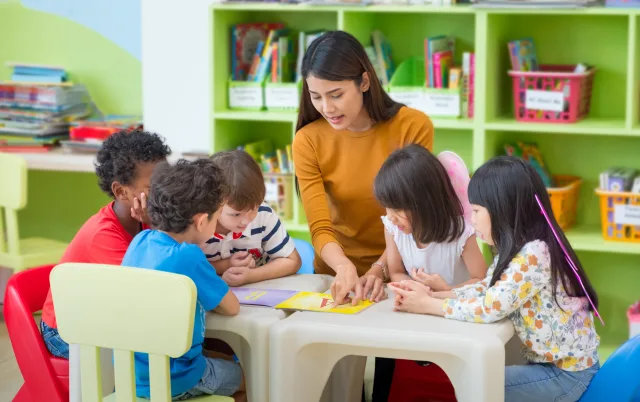
Children are drawn to creative activities from the beginning. Babies bounce to music, toddlers cover paper with scribbles, preschoolers turn everyday objects into props for imaginary worlds, and older children use creative projects to explore their interests and express themselves.
These activities are enjoyable, but they're also an important part of healthy development. Art for child development supports everything from fine motor control and language growth to emotional expression, problem-solving, and social skills.
This guide explores why creative arts matter and how families can support creative development from birth through adolescence.
Key Takeaways
- Creative arts — visual art, music, movement and dramatic play — support fine motor, emotional, cognitive, language and social development all at once.
- What creative play looks like changes a lot from infancy through adolescence, but the value of open-ended exploration stays constant.
- Research links early music exposure, preschool music training and creative movement to measurable gains in language and social skills.
- The strongest creative environments give kids access to real materials, unhurried time, and adults who create alongside them.
How Art Supports Child Development
Few activities ask children to use so many parts of themselves at once. When a child paints, sings, dances, or disappears into an imaginary world, they are using their hands, making decisions, communicating ideas, and learning from the results. The four major creative arts areas — visual art, music, movement and dance, and dramatic play — each offer different experiences, but they share something important: they help children learn by creating rather than simply consuming.
Fine Motor Development
Art gives children a reason to practice the small movements that eventually support writing, self-care, and everyday independence. Gripping a crayon, controlling a paintbrush, pinching collage materials, shaping clay, and cutting with scissors all strengthen the muscles and coordination children rely on later in school and daily life.
You can see this development unfold over time. Art grows alongside the child, providing new challenges as their abilities expand.
Emotional Development and Self-Expression
Children often express feelings through art before they can explain them with words. A frustrated child may pound clay. An excited child may dance across the room. A child working through a difficult experience may draw the same scene again and again.
Adults play an important role here. Children develop confidence when their effort and curiosity are noticed. "Tell me about your picture" or "I noticed you mixed those colors together" invites reflection in a way that simple praise often doesn't. Music and dramatic play also support emotional growth. A familiar song can calm a child after a difficult day. Pretending to be a doctor, teacher, superhero, or parent allows children to explore emotions and social situations from a safe distance.
Cognitive Development and Creative Thinking
Every creative activity contains small lessons in cause and effect. Children are constantly forming ideas, testing them, and adjusting based on what happens next. Dramatic play develops another important cognitive skill: narrative thinking. When children create characters, invent problems, and decide what happens next, they are learning how stories work. That ability supports reading, writing, and communication.
Language and Narrative Development
Creative arts and language development often grow together. Children talk about what they are making, explain their ideas, negotiate roles during pretend play, and tell stories through pictures long before they can write them down. Music is especially powerful because it helps children hear the patterns in language. Songs and rhymes introduce rhythm, repetition, and new vocabulary in ways that feel playful rather than instructional.
Social Development and Collaborative Creativity
Creative play is rarely solitary for long. Building a block city, staging a puppet show, or making up a game with rules teaches children to negotiate ideas, take turns and build on each other's contributions. These shared creative moments help children practice cooperation, compromise and communication skills they'll rely on well beyond the art table.
How Creative Arts Grow With Your Child
Babies & Toddlers
Exploration matters more than the finished product — texture, sound and sensation lead the way.
Preschool & Kindergarten
Children plan, tell stories and work with a specific creative goal in mind.
School-Age
Longer, more ambitious projects and a growing interest in technique and performance.
Adolescents
Art, music and digital creation become part of identity, voice and self-discovery.
Creative Arts Activities for Babies and Toddlers
For babies and toddlers, art is about exploration more than creation. A baby is often more interested in the feeling of finger paint than the picture it leaves behind. A toddler may spend ten minutes making marks with a crayon just to hear the sound it makes on paper.
Music is also beneficial to a baby's creativity and expression. A recent peer-reviewed infant study summarized by the NEA found that the home music environment—and especially parent singing—was positively correlated with infants' vocabulary comprehension, vocabulary production, and gesture production from 9 to 18 months.
Arts and Crafts Activities: Babies and Toddlers
-
Popsicle Art
Freeze a fruit puree or yogurt pop and let your child paint with it while seated in a high chair. The experience combines color, temperature, texture, and taste in a single activity. For many children, it's their first introduction to making art.
-
Paper Plate Cymbals
Give your toddler two paper plates and encourage them to crash them together like cymbals. Experiment with loud sounds and quiet sounds, fast rhythms and slow rhythms. Add a favorite song and see if they can match the beat.
-
Permanent Scribble Station
Keep paper and crayons where your toddler can access them every day. Frequent opportunities to draw build confidence and strengthen the hand control needed for later writing. The goal isn't a finished product—it's giving children regular opportunities to explore and create.
Creative Arts for Preschoolers and Kindergartners
Creative arts become more intentional during the preschool and kindergarten years. Children are still exploring materials and ideas, but they are also planning, storytelling, solving problems, and expressing themselves in increasingly sophisticated ways.
Art Projects for Preschoolers and Kindergarteners
By pre-K and kindergarten, children can stay with a project longer, work alongside other children, and create with a specific goal in mind. This is where art becomes a powerful tool for thinking. Children use drawings to tell stories, construction materials to solve problems, and creative projects to communicate ideas they may not yet be able to write down.
Art projects for kindergartners and preschoolers work best when they are open-ended, use real materials, and leave room for individual ideas. A nature collage, a cardboard sculpture, or a classroom mural invites much richer thinking than a craft kit where every child follows the same steps and ends up with the same result.
Music, Drama, and Movement at Preschool and Kindergarten Age
Music takes on a new role at this age. Children can sing recognizable songs, memorize favorite lyrics, and invent rhythms using anything that makes noise. Transition songs, clapping games, and call-and-response activities all strengthen the pattern recognition skills that support later learning.
Music also supports language development in measurable ways. In one study, more than 90% of preschool children improved on a verbal-ability measure after just 20 days of music training.
Movement matters, too. In an eight-week study of Head Start preschoolers, children who participated in creative dance and movement activities showed stronger social competence and fewer behavior challenges than children in a free-play comparison group.
Dramatic play becomes increasingly elaborate during the preschool and kindergarten years. Children blend real-world knowledge with imagination, creating storylines that can continue for hours or even days.
Creative Arts Activities for Preschoolers and Kindergartners
-
Who Are You Today?
Encourage costume play using whatever is available at home. A foil badge becomes an officer. A mixing bowl becomes a chef's hat. Follow your child's lead and join the story.
-
Music and Movement Questions
Play different styles of music and talk about what you hear. Does this song make you want to sway, march, or jump? How does it make you feel? These conversations help children connect music, emotion, and movement.
-
Sing-Along Inventory
When a song gets an enthusiastic response, add it to a family playlist. Over time, you'll build a soundtrack filled with favorite songs, new vocabulary, and shared memories.
Art Activities for School-Age Kids and After-School Programs
School-age children are ready to go deeper with creative arts. They have the attention span to tackle longer projects, the motor skills to work with more challenging materials, and the ability to connect creative work to their interests and experiences. That makes after-school hours especially valuable. In fact, art activities for afterschoolers are one of the most effective ways to turn unstructured time into meaningful learning.
Visual Art and Crafts for School-Age Kids
By this age, children are creating with intention. They experiment with materials such as watercolor, charcoal, paint, and mixed media. Their drawings become more detailed, their projects more ambitious, and their creative choices more deliberate. Many begin paying attention to the work of other artists and incorporating new techniques into their own creations.
This is also the age when the fine motor control built over years of art practice really begins to show in increased precision and range.
Music, Drama, and Performance Arts at School Age
Many school-age children begin developing a serious interest in music. Some want to learn an instrument. Others become fascinated by songwriting, rhythm, or performance. If your child is ready to explore music more deeply, check out our guide to the best musical instruments for kids to start with.
Drama also becomes more sophisticated during the school-age years. Children act out scenes from favorite books, create original characters, and build storylines that unfold over multiple play sessions. They begin considering not only what happens in a story, but why characters make the choices they do.
This kind of dramatic play develops empathy, perspective-taking, and communication skills. Children learn to imagine experiences beyond their own while collaborating with others to create a shared story.
Improv games can help build drama skills. See our top improv games here.
Arts and Crafts Activities: School-Age Kids and After-School Programs
-
Nature's Palette
Collect natural materials during a walk and use them to create a landscape, pattern, or abstract collage. Encourage children to notice colors, textures, and shapes they might otherwise overlook.
-
Storybook Creator
Brainstorm characters, develop a simple plot, sketch illustrations, and bind the pages into a finished book. This activity blends visual art, language, and narrative thinking.
-
Instrument of the Week
Choose a different instrument each week. Listen to it in different musical genres, watch a performance, or try a beginner tutorial. Talk about how the instrument changes the feeling of a song.
Creative Arts for Adolescents
By early adolescence, creative arts are often becoming part of a young person's identity. For many 11- to 14-year-olds, art, music, drama, photography, or digital creation is how they explore interests, process emotions, and communicate who they are.
Art as Identity, Voice, and Self-Discovery
Adolescents begin developing a creative voice of their own. A sketchbook may become a visual diary. A camera roll may fill with carefully composed photographs. A young artist who once experimented with every material available may start gravitating toward a particular style, subject, or technique.
Adolescents are not simply creating for the experience of creating. They are making choices about what matters to them, what they want to say, and how they want to be seen.
Music, Drama, and Digital Creative Expression
For many adolescents, music becomes deeply personal. Some spend hours building playlists that reflect their moods and interests. Others learn an instrument, write songs, or begin experimenting with digital music production.
Drama evolves, too. Adolescents often become interested in character motivation, conflict, and social themes. What starts as pretend play in early childhood can grow into scriptwriting, performance, filmmaking, or storytelling with a specific message or point of view.
Arts and Crafts Activities: Adolescents
-
Stop-Motion Animation
Use clay, action figures, drawings, or found objects to create a stop-motion film one frame at a time. This activity combines visual art, storytelling, planning, and basic filmmaking techniques.
-
Music Mashup
Experiment with a free digital audio app to layer beats, instruments, and melodies into an original piece of music. It's an accessible introduction to music production and sound design.
-
Create Your Own Comic Book
Develop characters, build a plot, sketch illustrations, and design page layouts. Comic creation combines drawing, storytelling, visual communication, and creative decision-making.
Supporting Creative Arts at Home and in Child Care
Across every age and setting, strong creative environments have a few things in common: materials children can access independently, enough time to explore without rushing, diverse art and music that reflect many cultures and experiences, and adults who create alongside children rather than simply directing them. Most of all, they value the process of creating.
To learn more about your child's development, visit our Developmental Milestones page and explore the Play and Learning Hub for your child's current stage: Baby, 1-Year-Old, 2-Year-Old, 3-Year-Old, School-Age, or Adolescent.