
PLAY & LEARNING · MATH
Math Activities for Kids: Building Number Sense from Birth to Adolescence
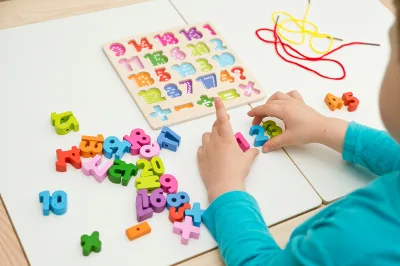
Long before anyone hands a child a worksheet, they’re doing math. A baby drops a spoon off the high chair for the tenth time to see if it falls the same way twice. A toddler insists her cracker pile has to match her brother’s, or there will be tears. A preschooler announces, with total confidence, that the moon is “way bigger than a hundred.” These are math activities in disguise, and they start earlier than most parents realize.
This guide makes the case for why math matters at every age, then hands you age-by-age activities that build on it. If math brings up some old baggage from your own school days, you’re far from alone. Plenty of adults carry a complicated relationship with the subject into parenthood. Nothing here involves flashcards, timed drills or a single wrong answer. Every child develops mathematical thinking on a different timeline, and the ideas below are meant to support that growth, not measure it against a checklist.
Key Takeaways
- Math begins in infancy. Babies compare amounts, track patterns and explore space well before they can count.
The best early math activities rarely look like school. Sorting socks, splitting a snack fairly and counting out forks for dinner all build number sense.
Strong early math skills are linked to advantages that show up years later, well into the school-age years and beyond.
How Math Supports Child Development
Math isn’t a subject that switches on in kindergarten. It’s a way of making sense of the world that starts in the crib and keeps expanding for another decade and a half. Math is important because the sorting, comparing, counting and building children do as toddlers and preschoolers is the scaffolding that formal instruction later climbs. What follows spans that entire arc as a single thread of thought that grows more sophisticated over time.
Number Sense and Early Numeracy
Number sense is the gut-level feel for quantity: knowing that five is more than two without stopping to count, or noticing right away that a group got smaller. It isn’t something you can hand a child directly. It’s built through thousands of small encounters with amounts, one snack, one step and one toy at a time.
Watch how this unfolds without any formal teaching. An infant will stare a beat longer at a group of blocks if one has quietly vanished, as though the missing block doesn’t add up. A toddler starts reaching for “two” cookies instead of just “some.” A preschooler can finally point to each object once while counting, matching one word to one thing, which is a genuine leap from reciting numbers like a nursery rhyme. Later, a school-age child bends that same instinct toward fractions and decimals, asking whether three-quarters of a pizza is more or less than five-eighths.
Children with solid number sense aren’t just fast at math facts. They understand why those facts hold true, so they can bend an idea to fit a new problem without falling back on memorized steps. That’s why the best math activities for preschoolers feels like play. A study tracking infants’ number sense into early childhood found that a preverbal sense of quantity predicts later standardized math scores, even after accounting for general intelligence — a sign that this instinct for amounts is doing cognitive work long before a child ever sees a number written down.
Spatial Reasoning and Geometry
If number sense is math’s foundation, spatial reasoning is its framework. It’s the ability to picture how objects fit, rotate and relate to one another in space, and it turns out to be one of the strongest known predictors of later success in science, technology, engineering and math (STEM) fields as a group.
This skill grows almost entirely through hands-on play. Stacking rings, drawing and construction sets are among the simplest STEM activities that caregivers can offer. The benefits compound over years of repeated play. A 2025 study from Florida International University found that children as young as three use the same mental strategies adults do to solve puzzles, mentally rotating objects in their minds quickly and accurately, a far cry from guessing or copying.
The language caregivers use during that play matters more than it seems. Casually saying, “put the ball behind the couch” or “you’re taller than your sister now” hands a child spatial vocabulary that will later anchor geometric concepts like angle, distance and rotation.
Spatial ability also shows one of the more persistent gender gaps in school-age testing. Research traces that gap mainly to practice, not innate ability. That’s good news for families. Generous, repeated spatial play in early childhood benefits every child, regardless of how the gap eventually shakes out.
Logical Thinking and Problem-Solving
Strip math down to its core and it’s a form of logical reasoning. Spot the pattern, guess what comes next, test the guess and adjust if you’re wrong. Children practice this constantly through play, well ahead of any formal lesson on the topic. A child who builds a block tower, watches it topple and rebuilds it with a wider base is running the same loop an engineer runs at a drafting table.
Pattern recognition is where this reasoning starts. Sorting toys by color, finishing a rhythm, guessing what comes next in a sequence of stripes — each is an early rehearsal for the pattern work that algebra and data analysis will eventually formalize. Games with built-in strategy, whether a board game, card game or memory game, are especially efficient at building this kind of thinking because they demand planning, sequencing and the ability to weigh a few moves ahead, all while a child is having fun and doesn’t notice the exercise.
When Math Feels Hard: Understanding Dyscalculia
Some children build these skills on a different timeline, and that difference has a name. Dyscalculia is a specific learning profile that affects number sense, arithmetic fluency and the ability to work with numerical information, and it’s more common than most parents assume, with estimates suggesting it affects somewhere between 3% and 7% of the population.
Common dyscalculia symptoms include ongoing trouble with counting, recognizing numbers, reading a clock or recalling basic math facts, even after plenty of practice, along with confusion over which of two amounts is larger. None of this reflects low effort or low intelligence. Dyscalculia is a neurological difference in how the brain processes numbers, and it’s distinct from math anxiety, though the two frequently show up together.
A child who struggles with math isn’t “bad at it.” They may simply be wired to learn it differently, and the earlier that difference is identified, the more doors stay open for them. If you notice persistent difficulty that goes beyond typical variation, your child’s school or childcare provider is a good first stop for evaluation and support. Our Developmental Milestones page is also a helpful starting point for understanding what’s typical at each age.
Babies & Toddlers
Birth–12 Months | Patterns and spatial play | Babies test the world by filling, dumping and stacking. Long before counting begins, they’re noticing routines and experimenting with how objects relate in space.
1–2 Years | First number words | Toddlers start using words like “more,” “big” and “all gone,” building the comparison language that formal number work will later depend on
2–3 Years | Sorting and classifying | Two-year-olds sort by color, shape and size, and start to expect predictable sequences. These early classification skills underpin logical thinking.
Preschool & Kindergarten
3–4 Years | Counting with meaning| Preschoolers count with one-to-one correspondence, recognize basic shapes and begin to grasp “how many” as an actual quantity.
4–5 Years | Operations and patterns | Pre-kindergarteners experiment with adding and taking away, spot repeating patterns and build spatial awareness through construction and measuring.
5–6 Years | Numeracy and computation | Kindergarteners work confidently with numbers past 20, compare quantities and take their first steps into formal addition and subtraction.
School-Age
6–10 Years | Computation and reasoning | School-age children gain fluency across all four operations, encounter fractions, geometry and data and start applying math thinking to problems outside the classroom.
Adolescents
11–14 Years | Abstract thinking | Adolescents develop proportional reasoning, algebraic thinking and statistical literacy, the groundwork for high school math and beyond.
Math Activities for Babies and Toddlers
For this age group, math has nothing to do with worksheets. A baby who reaches for the bigger half of a banana is comparing size before she has a word for it. A toddler who won’t settle down until her stuffed animals are lined up, biggest to smallest, is doing serious sorting work, whether he’d call it that or not.
What Math Looks Like at This Age
Object permanence, the understanding that something still exists even out of sight, is an early mathematical idea in its own right. It reinforces counting and the notion that quantities persist even as a set changes. Babies and toddlers are also constant spatial experimenters, testing whether one object fits inside another, what happens when something gets thrown and whether a surface will hold weight. This is informal physics and geometry, running in parallel. Simple math activities at this age are already building the number sense that underlies why math is important for everything that comes later.
Hearing number words woven into daily life, like “here are your two socks” or “let’s count the stairs together,” builds number vocabulary well before a child grasps what numbers formally mean. For age-specific developmental detail, our Baby Hub, 1-Year-Old Hub and 2-Year-Old Hub go deeper on what’s typical at each stage.
Math Activities for Babies and Toddlers
-
Narrate Everything You Count
Stairs, grapes, bath toys, fingers — count them out loud as a matter of habit. The goal isn’t memorization, it’s linking counting to quantities in the real world.
-
Fill and Empty Containers
A set of stacking cups teaches volume, spatial reasoning and cause and effect all at once, and it will hold a toddler’s attention far longer than you’d expect.
-
Sort By One Clear Rule
Gather a pile of mixed socks and sort them together. “All the stripes are here, all the solids are there.” Classification is an early gateway into logical reasoning.
-
Play With Shape Sorters
Matching a shape to its matching hole builds spatial reasoning and problem-solving, and naming each shape as you go adds vocabulary as a bonus.
-
Lean on Comparison Words
“Big spoon,” “little cup,” “more juice,” “all gone” — this kind of everyday language builds the foundation for number sense long before formal counting begins.
-
Clap Out a Pattern
A simple rhythm your child can copy back builds the same pattern-recognition muscle that later shows up in number sequences.
Math Activities for Preschoolers and Kindergartners
Preschool and kindergarten are when number sense starts to show its work. Children are counting with intention, matching numbers to actual quantities, sorting with a plan in mind and starting to grasp that amounts can grow or shrink. The math activities for preschoolers that matter most right now aren’t complicated. Simple, repeated math activities woven into daily routines build the foundation on which formal instruction will eventually be built.
What Math Looks Like at This Age
One-to-one correspondence, such as pointing to a single object for each number word spoken, marks the jump from reciting numbers to understanding them. Around age four or five, children begin to grasp and lock in cardinality, the concept that the last number counted tells you the total size of the group. Comparison becomes a favorite game at this age too, with children endlessly measuring who’s taller, whose cup holds more and whose block tower reaches higher. Many preschoolers can also solve simple addition and subtraction using physical objects well before they ever see a plus or minus sign. Our 3-Year-Old Hub, Pre-Kindergartener Hub and Kindergartener Hub cover what’s developmentally typical for your child’s specific age in more detail.
Math Activities for Preschoolers and Kindergartners
-
Building a Counting Collection
Gather buttons, pennies or small toys and count them together, then recount after adding or removing a few. It’s cardinality and simple addition in one activity.
-
Go on a Number Hunt
Look for numbers on a walk: house addresses, bus signs, price tags, clock faces. Noticing numbers in the world builds the same kind of print awareness that supports early reading.
-
Measure With Your Body
Ask how many hand-lengths long the couch is, or how many steps it takes to reach the kitchen. Non-standard measurement lays the groundwork for the proportional thinking that rulers will later formalize.
-
Extend a Pattern
Line up buttons or pieces of cereal in a repeating sequence and ask your child to guess what comes next.
-
Play Classic Number-Based Board Games
Games like Chutes and Ladders or Hi Ho Cherry-O build counting and quantity comparison in a format kids find fun rather than instructional.
-
Cook Together
Measuring and pouring ingredients side by side introduces early fractions when you halve a recipe and early multiplication when you double one.
Math Activities for School-Age Kids
Math expands quickly during the school-age years. Children move from counting to computing, from comparing amounts to calculating them and from naming shapes to reasoning about geometry formally. The math and STEM activities that work best now take abstract ideas and make them tangible, tying math to things kids already care about.
What Math Looks Like at This Age
School-age children are building fluency across addition, subtraction, multiplication and division while also working out why those operations behave the way they do. Fractions and decimals are among the bigger conceptual hurdles of this stretch. Kids who understand a fraction as both a division problem and as a piece of a whole tend to have an edge going forward.
Around age seven or eight, data literacy starts to matter too, as children begin reading simple graphs, running basic surveys and drawing conclusions from what they find. This is also, unfortunately, the age when math anxiety often takes hold, especially once grades and peer comparison enter the picture, which makes a low-pressure, exploratory approach to activities especially valuable. Our School-Age Hub has more information on what’s developmentally typical at this stage.
Math Activities for School-Age Kids
-
Scale a Recipe
Doubling or halving ingredients makes fractions and multiplication click, since something edible is riding on getting the math right.
-
Plan a Hypothetical Budget
Give your child a set amount and a goal, like stocking a school-supply kit for $15, and let them work out the arithmetic.
-
Turn a Survey Into a Graph
Ask family members a question, such as favorite movie, hours of sleep or steps walked in a day, then chart the results together as a bar or line graph.
-
Bring on the Strategy Games
Chess, Battleship and similar games build spatial reasoning, probability thinking and planning without feeling anything like schoolwork.
-
Try a Bridge-Building Challenge
Using only index cards and tape, see how much weight a bridge can hold before it buckles. It’s structural reasoning and trial-and-error testing rolled into one, and a natural bridge (no pun intended) to our STEM hub.
-
Explore an Adaptive Practice app
Platforms like Khan Academy or Prodigy adjust to a child’s level and present math in a game-like format, which can ease some of the pressure that builds around this age.
Math Activities for Adolescents
Middle school math asks teens to think abstractly for the first time. Variables, ratios, early algebra and statistics all require a conceptual leap that’s new territory for most students. The math STEM activities that resonate most at this age connect directly to a teenager’s actual life and help rebuild the confidence that so often erodes during these years.
What Math Looks Like at This Age
Proportional reasoning — thinking in ratios, rates and percentages — supports nearly everything that comes next in algebra, geometry and STEM more broadly. Algebraic thinking introduces the ideas that a letter can stand in for an unknown quantity, and that a relationship between numbers can be described in general terms rather than one example at a time.
Statistical literacy also takes shape now, as teens learn to question a sample size, spot a misleading graph and reason in terms of probability. This is exactly where math activities need to evolve alongside the thinking, trading concrete objects for abstract reasoning.
Underneath all of it sits something less visible. Adolescents are quietly deciding whether they’re a “math person.” How adults talk about math ability affects whether kids stick with it. Framing it as a skill built through effort versus a fixed trait you either have or don’t, makes a difference. Our Adolescent Hub covers in more depth what’s developmentally typical at this stage.
Math Activities for Adolescents
-
Personal Budget Simulator
Hand your teen a monthly income and a list of expenses and have them make it balance. Percentages, trade-offs and even compound interest show up on their own.
-
Investigate a Real Question With Data
Pick something they’re curious about. Does shoe size track with height? Do higher review scores predict box office success at the movies? Find or collect the data and dig in.
-
Write a Simple Program
Using Python, JavaScript or Scratch, have your teen build something small but useful, like a tip calculator or unit converter, connecting math directly to code. Our STEM Hub has more on pairing math with technology.
-
Design an Escape Room Challenge
Challenge them to build a math-based puzzle for a younger sibling. Working backward from a solution is a surprisingly advanced algebraic skill.
-
Run a Probability Experiment
Flip a coin, roll dice or draw cards repeatedly and compare the results to what theory predicts. It’s a hands-on way to internalize that probability describes patterns over many trials, not any single outcome.
Supporting Math at Home and in Childcare
Across ages and settings, environments that raise confident mathematical thinkers tend to share a few habits. They treat math as more than just procedures to memorize. They view math as a lens for understanding the world. A wrong answer becomes part of the thinking process instead of a failure to avoid. And they skip the worksheets, handing children actual problems to work through.
The same holds true outside the home. Strong childcare programs keep math materials, like measuring tools, sorting bins and pattern blocks, woven into everyday play. They don’t wait for a designated lesson time to bring them out. Caregivers who narrate quantities and comparisons throughout the day, without making a production of it, do more for number sense than any flashcard set. What matters most is a culture where curiosity about numbers, shapes and patterns is welcomed, never corrected.
For more on your child’s overall development, visit our Developmental Milestones page, and see our STEM Hub for how math connects to science, technology and engineering learning at every age. You can also explore our age-by-age guides for more on what your child is learning across every subject: Baby Hub, 1-Year-Old Hub, 2-Year-Old Hub, 3-Year-Old Hub, Pre-Kindergartener Hub, Kindergarten Hub, School-Age Hub and Adolescent Hub.