
PLAY & LEARNING · STEM
STEM Activities for Kids: Science, Technology, Engineering and Math from Birth to Teen
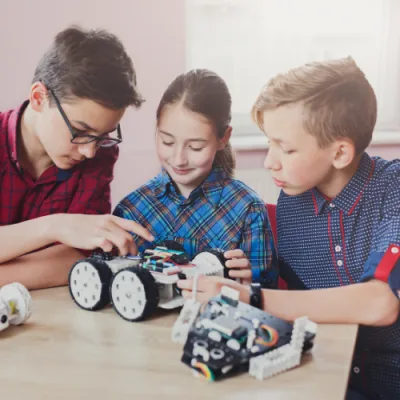
STEM stands for Science, Technology, Engineering and Mathematics, four disciplines that become even more powerful when children experience them together instead of as separate subjects. This guide explores STEM activities for kids from birth through adolescence, showing how scientific thinking, engineering habits, technology literacy and mathematical reasoning grow together over time. You'll also find practical ways families and childcare providers can encourage STEM learning at every stage using everyday materials and experiences.
If you'd like to dive deeper into one area of STEM, explore our Science Hub for scientific thinking and discovery or our Math Hub for mathematical development and numeracy. This page focuses on the integrated STEM approach, with special attention to engineering and technology as children grow.
Key Takeaways
STEM thinking grows through play as children build, investigate, experiment and solve everyday problems.
You don't need special equipment or a STEM background. Curiosity, simple materials and thoughtful questions are enough.
Engineering for kids follows a simple cycle: identify a problem, imagine a solution, build it, test it and improve it.
How STEM Supports Child Development
Children use STEM to make sense of the world around them. As they ask questions, test ideas, solve problems and try again after setbacks, they build persistence, confidence and flexible thinking that support learning across every area of development.
Science encourages observation and curiosity, mathematics helps children measure and reason, engineering challenges them to design and improve solutions and technology provides the tools to put ideas into action.
Science and Observation
Every STEM journey begins with curiosity. When children stop to watch a ladybug crawl across a leaf, wonder why ice melts or ask what will happen if they mix two colors of paint, they're developing the habits that support lifelong scientific thinking.
Spaghetti and meatballs can even be a platform for scientific discovery. Check out our blog to learn more.
Scientific thinking begins during infancy through sensory exploration and continues to grow throughout childhood and adolescence. As children gain new experiences, they become more confident asking questions, looking for patterns and testing their ideas about how the world works.
If you'd like to explore scientific thinking in greater depth, including age-specific activities and developmental milestones, visit our Science hub.
Engineering Thinking and the Design Cycle
Engineering for kids begins with a simple question: How can I make this work better? Whether a child is building a bridge for toy cars or designing a paper airplane, they're following the same process engineers use every day. They identify a problem, imagine a solution, build it, test it and make changes based on what they learn.
That process grows alongside children. A preschooler might discover their block bridge needs another support before a toy car can cross it. A school-age child may redesign a tower so it can hold more weight. A teenager might adjust the code for a robot after seeing it miss its target. The challenges become more complex over time, but the habit of testing and improving stays the same.
One of the greatest benefits of engineering is that it helps children see mistakes as valuable information. A design that falls over or doesn't work the first time isn't a failure. It's an opportunity to ask, What can I change? That willingness to revise, experiment and try again builds resilience that extends well beyond STEM.
Technology Literacy
Technology skills develop over time. Young children learn to use simple tools and begin recognizing patterns and sequences through everyday play. As they grow, those experiences lay the groundwork for coding, computational thinking and digital problem-solving. Breaking a challenge into smaller steps, noticing patterns and following or creating a sequence are all important technology skills.
As children become more independent technology users, they also benefit from thinking critically about the tools they use every day. Asking who designed a technology, what problem it solves and how it shapes the way people live helps children become thoughtful, informed users who understand that technology is created by people and can always be improved.
Mathematics and Quantitative Reasoning
Math helps children make sense of the world around them. That skill has a name: quantitative reasoning, which is using numbers and measurements to compare things, solve problems and make decisions. Whether they're measuring ingredients for a recipe or comparing the distance two toy cars travel, they're using mathematical reasoning to solve real problems. These everyday experiences are at the heart of many STEM activities, showing children that math is a practical tool for exploring, building and making decisions.
Mathematical thinking begins in infancy, as babies notice differences in quantity and patterns, and continues to develop throughout childhood and adolescence. As children develop, they learn to measure, compare, estimate, collect data and recognize relationships that help them better understand the world around them.
For a closer look at how math skills develop over time, along with age-specific activities to support them, explore our Math Hub.
Babies & Toddlers
Birth–12 Months | Cause and Effect | Babies explore STEM by dropping, pushing, pulling and splashing. Every action helps them discover how the physical world responds.
1–2 Years | Building and Rebuilding | Toddlers stack, fill, empty and knock things down to see what happens. These simple experiments lay the foundation for engineering and mathematical thinking.
2–3 Years | Sorting and Simple Tools | Young children sort, categorize, count and use everyday tools like spoons, ramps and containers to solve problems and explore how things work.
Preschool & Kindergarten
3–4 Years | Design and Build | Preschoolers can build with a goal in mind, then change their designs as they learn what works. This is the beginning of the engineering design cycle.
4–5 Years | Test and Improve | Pre-kindergartners enjoy testing ideas against a challenge, making changes and trying again. Each redesign builds confidence alongside STEM skills
5–6 Years | Patterns and Coding | Kindergartners recognize patterns, follow sequences and enjoy simple coding activities that strengthen logical and computational thinking.
School-Age
6–10 Years | Engineering Challenges | School-age children can tackle open-ended design challenges, collect data, improve their ideas and begin exploring coding and robotics..
Adolescents
11–14 Years | Systems and Robotics | Adolescents can design systems, program robots, analyze data and apply STEM thinking to solve meaningful, real-world problems.
STEM Activities for Babies and Toddlers
Curiosity starts early. Babies and toddlers naturally investigate the world by reaching, rolling, stacking, pouring and repeating actions to see what happens next. A safe environment, simple everyday objects and an adult who encourages exploration with questions and observations create countless opportunities for early STEM learning.
What STEM Looks Like at This Age
As children explore, they begin noticing relationships between objects. They learn that a ball can roll under the couch and still exist, that a large container holds more than a small one and that stacking, sorting and fitting objects together changes the way they can be used. Every day experiences like these lay the foundation for later learning in science, engineering and math.
During the second year of life, simple tools become part of play. A spoon helps reach an object, a container carries treasures from one room to another and a ramp changes the path of a rolling ball. Along the way, babies and toddlers are also recognizing patterns in sounds, movements and routines, building the early thinking skills that support mathematics, engineering and even future coding.
For more age-specific guidance, visit our Baby, 1-Year-Old and 2-Year-Old Hubs.
STEM Activities: Babies and Toddlers
-
Explore Ramps Together
Prop up a piece of cardboard or a sturdy board to create a simple ramp, then gather balls, toy cars and other objects to see what happens. Encourage your child to test which objects roll, which stay put and how changing the angle affects the results. This simple activity introduces early engineering and physics through play.
-
Stack, Nest and Build
Offer blocks, nesting cups, cardboard boxes or other stackable objects and let your child experiment. As towers grow, topple and are rebuilt, children begin understanding size, balance and spatial relationships while discovering that changing a design can produce a different result.
-
Splash and Pour
Fill a shallow bin with water and provide cups, funnels, spoons and squeeze bottles. Pouring, filling, emptying and transferring water introduces concepts like volume, flow and cause and effect while encouraging children to make observations and test their ideas.
STEM Activities for Preschoolers and Kindergartners
Preschoolers and kindergartners are eager to tackle challenges that have more than one possible solution. They enjoy building, testing, measuring and making changes as they discover what works, making this an ideal time to introduce simple engineering challenges and hands-on problem-solving. The goal isn't finding the "right" answer. It's giving children opportunities to think, experiment and improve their ideas.
What STEM Looks Like at This Age
Whether they're creating a home for a stuffed animal or building the tallest block tower they can, children are learning that good ideas often come from testing, adjusting and trying again.
Measurement also becomes more meaningful during these years. Children compare lengths, count how many blocks tall a tower is and begin using simple tools like rulers, measuring cups and scales with adult guidance. These hands-on experiences help connect numbers to the real world in ways that feel useful and engaging.
As they play, children also strengthen the thinking skills that support future STEM learning. Clapping patterns, sorting objects and predicting what comes next build early mathematical and computational thinking, while playground equipment and everyday toys introduce simple machines like ramps, levers and wheels. These experiences help children recognize that the objects around them are designed to solve problems.
For more age-specific activities and developmental guidance, visit our 3-Year-Old, Pre-Kindergartener and Kindergartener Hubs.
STEM Activities: Preschoolers and Kindergartners
-
Bridge Challenge
Challenge your child to build a bridge between two stacks of books using only paper. Test how many pennies or small blocks it can hold before it bends or collapses, then encourage them to improve the design and try again. This is a fun introduction to engineering for kids, helping children explore structural support, problem-solving and the engineering design cycle.
-
Build a Marble Run
Use cardboard tubes, tape and a box or wall to create a marble run. Experiment with different ramp heights, turns and pathways, then make changes to see how they affect the marble's speed and movement. Along the way, children explore gravity, momentum, measurement and engineering through hands-on experimentation.
-
Play Unplugged Coding Games
Create a simple obstacle course and use direction cards like "forward," "turn left" and "turn right" to guide a family member from start to finish. Then switch roles and let your child become the programmer. This screen-free activity builds computational thinking by helping children break problems into clear, logical steps while discovering how precise instructions lead to successful outcomes.
STEM Activities for School-Age Kids
School-age children are ready to tackle STEM challenges that require planning, testing and creative problem-solving. They can collect data, compare results, use digital tools and apply what they learn to solve real-world problems, especially when there are multiple ways to succeed. Open-ended challenges encourage children to think like engineers by asking questions, trying new ideas and improving their designs over time.
What STEM Looks Like at This Age
School-age children are ready to take on STEM challenges that look more like the problems engineers solve every day. They can work within limits like a budget, a time frame or a set number of materials, then test different solutions to see which one works best. These kinds of constraints encourage creativity by challenging children to think carefully about every decision they make.
Children at this age can also collect and organize information in meaningful ways. They can measure results over multiple trials, record observations, compare data and begin looking for patterns that help explain why one approach worked better than another. These experiences strengthen math skills while showing children how data can be used to answer real questions.
As technology becomes a larger part of their lives, many school-age children are also ready to explore coding and robotics for kids. Block-based coding programs help children learn how to break problems into logical steps, while beginner robotics kits bring science, technology, engineering and math together in a hands-on way. Watching a program come to life gives children immediate feedback and encourages them to keep testing, revising and improving their ideas.
For more age-specific activities and developmental guidance, visit our School-Age Hub.
STEM Activities: School-Age Kids
-
Design an Egg Drop Challenge
Challenge your child to design a container that will protect a raw egg during a drop using a limited set of materials like paper, tape, straws and rubber bands. After each test, talk about what worked, what didn't and what changes might improve the design before trying again. This classic engineering challenge introduces concepts like force, energy absorption and the process of testing an idea, fixing what doesn’t work and trying again.
-
Create a Scratch Project
Using the free platform Scratch (scratch.mit.edu), encourage your child to design an interactive story, animation or simple game based on their own interests. As they build their project, they'll learn computational thinking, sequencing and programming logic while expressing their creativity through technology.
-
Build a Water Filtration System
Provide a plastic bottle, sand, gravel, cotton balls and other safe household materials, then challenge your child to design a simple water filter. Test different designs by pouring muddy water through each one and comparing the results. Children practice engineering design, observation and data collection while exploring how STEM can help solve real-world environmental problems.
Check out our blog on STEM activities at home for more ideas.
STEM Activities for Adolescents
Teens are ready to tackle projects with real-world applications, from writing software and building robots to conducting research and designing solutions to challenges they care about. This is the stage where STEM becomes less about completing an activity and more about thinking like a scientist, engineer or programmer.
What STEM Looks Like at This Age
Adolescents are developing the ability to think about complex systems rather than isolated ideas. They can explore how changing one variable affects an entire system, whether they're studying ecosystems, designing a computer program or investigating how cities manage energy and transportation. This kind of systems thinking is a foundation for engineering, environmental science, computer science and many other STEM careers.
They're also ready to ask their own research questions and investigate them using evidence. Teens can move beyond step-by-step experiments to identifying variables, designing investigations, collecting and analyzing data and drawing conclusions supported by evidence. These experiences help them develop the critical-thinking skills that scientists and researchers use every day.
Technology becomes an even more powerful learning tool during adolescence. Many teens are ready to explore text-based programming languages like Python or JavaScript, tackle more advanced robotics for kids platforms or experiment with emerging technologies like artificial intelligence and machine learning. The goal isn't to become an expert overnight. It's about gaining confidence in using technology to solve meaningful problems.
These experiences also shape how young people see themselves. Adolescence is often when students begin deciding whether STEM is "for them." Positive, engaging experiences, supportive mentors and seeing people from diverse backgrounds succeeding in STEM can all help young people develop the confidence to pursue future opportunities in science, technology, engineering and math.
For more age-specific activities and developmental guidance, visit our Adolescent Hub.
STEM Activities: Adolescents
-
Build a Python Project
Learning Python is one of the most valuable STEM activities for teenagers because it introduces a programming language used in science, engineering, artificial intelligence and data analysis. Start with a simple project, such as a calculator, quiz game or text analyzer, then continue adding new features over time. Building something that works encourages logical thinking, creativity and persistence while developing a highly transferable technical skill.
-
Join a Robotics Team
Programs like FIRST®, VEX® and BEST Robotics give teens the opportunity to design, build and program robots while working as part of a team. These competitions combine coding, engineering, problem-solving and communication in a way that mirrors real-world STEM careers. While many people think of robotics for kids as an elementary activity, robotics programs become increasingly sophisticated during the teen years, giving students opportunities to tackle complex engineering challenges alongside mentors and peers.
-
Solve a Real-World Engineering Challenge
Invite your teen to identify a problem they care about and design a solution. They might create a device that makes everyday tasks easier for an older adult, develop a system to reduce food waste or design a more accessible space in their school or community. These authentic engineering for kids experiences show how science, technology and engineering can improve people's lives while helping teens think critically, test ideas and refine their solutions through iteration.
Supporting STEM at Home and in Childcare
You don't need to be a scientist, engineer or programmer to nurture a child's interest in STEM. Some of the best STEM activities begin with a simple question: What do you think will happen? By wondering alongside your child, encouraging them to test their ideas and viewing mistakes as part of the process, you help build the curiosity and confidence that fuel lifelong learning. A little patience and a willingness to embrace a bit of mess often go much further than expensive kits or specialized equipment.
If you're choosing a childcare program or preschool, look for environments that encourage exploration over memorization. The strongest programs also include design challenges with multiple possible solutions, giving children opportunities to explore engineering for kids, experiment with robotics for kids and discover that there is often more than one way to solve a problem.
Continue exploring with our companion resources on Science and Math Hubs, where you'll find more activities and guidance to help children ask questions, solve problems and discover how the world works.