
Your School-Ager (6-10)
Learning and Development For Kids Ages 6-10
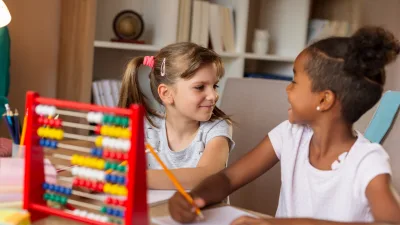
During the school-aged years, children grow creatively, physically, socially and academically. They are solving harder problems, building stronger friendships, asking bigger questions and discovering what makes them feel confident.
This guide explores the many ways children learn during these years, including creative arts, social-emotional development, math, physical growth, science, social studies, language and play and exploration. Use these ideas as a guide, not a checklist. Remember that every child develops at their own pace and in their own way.
For a closer look at what your child may be doing year by year, visit our Developmental Milestones page.
Key Takeaways
School-age children are building independence, problem-solving skills and confidence through both structured activities and time to explore their own interests.
Between ages 6 and 10, children make major progress in reading, logical reasoning, emotional regulation and understanding different perspectives.
Friendships become increasingly important during these years as children learn cooperation, communication and how they fit into the world around them.
Learning and Play Through Creative Arts for School-Aged Children
School-age children bring new purpose to creative work. They are no longer just exploring what a paintbrush can do or how an instrument sounds. They are creating something that matches the idea in their head and learning the patience, problem-solving and confidence it takes to bring that idea to life.
Visual Art and Making
During the school-age years, children gain fine motor control to take on more detailed creative projects. They can use smaller tools, plan what they want to make and return to a project across multiple days.
Open-ended maker activities like collage, sculpture, printmaking and mixed media projects give children room to experiment. When there is no single correct outcome, children practice making decisions, solving problems and trying again when something doesn't turn out exactly how they imagined.
Music, Theater and Performance
At this age, many children are ready for creative activities that require practice over time. Learning an instrument, reading simple music, singing in a group or preparing for a performance all build focus and the ability to work toward a goal.
Check out our guide on the seven best musical instruments for kids here.
Theater and dramatic play also become more complex during the school-age years. Children write scripts, create costumes, build props and develop characters with their own personalities and motivations. These experiences support storytelling skills, communication and the ability to see situations from another person's point of view.
Signs of Learning at Childcare
A strong childcare environment gives school-age children the freedom and materials to create their own ideas. Look for access to a variety of supplies, including paints, building materials, recycled items, fabrics and tools beyond basic crayons and paper.
Children's work should reflect their individual choices rather than a room full of identical projects. Caregivers should ask about creative decisions, encourage experimentation and provide opportunities for storytelling, music, performance and hands-on making throughout the week.
Play Ideas: Creative Arts for School-Age Children
Stop-Motion Film
Use a tablet or phone to photograph a scene one small movement at a time. When the pictures play together, your child has created a short movie. This activity combines storytelling, technology, planning and patience.
Comic Strip Story
Fold a piece of paper into six or eight panels and challenge your child to tell a complete story. Creating characters, dialogue and scenes builds writing skills and visual thinking.
DIY Puppet Theater
Make puppets from socks, paper bags or craft supplies, then create a stage from a cardboard box. Writing the story, making the characters and performing for others combines multiple creative skills in one project.
Looking for more educational activities for kids at home that encourage imagination and self-expression? Visit our Creative Arts Hub for more ways to help your child create, perform and explore.
Social-Emotional Development: Friendships, Identity and Belonging
The school-age years are when friendships start to carry a new kind of importance. Children ages 6-10 are figuring out who they are through the teams they join, the friends they choose and the interests they make their own. Along the way, they are building lifelong skills like managing conflict, understanding different perspectives and handling disappointment.
Building Friendships and Navigating Peer Relationships
Friendship looks different during the school-age years. Children begin moving beyond simply enjoying the same activity toward deeper relationships built on trust, shared interests and understanding another person's point of view.
This is also the age when friendship challenges can feel especially big. Children may experience changing friend groups, disagreements, hurt feelings or worries about being included. These moments are difficult, but they also create opportunities to practice communication, problem-solving and empathy.
Self-Concept, Confidence and Emotional Regulation
The way adults respond to challenges at this age matters. Praising effort, practice and problem-solving helps children understand that skills can grow over time. A child who says, "I'm not good at this yet," is building a very different relationship with challenges than a child who believes their abilities cannot change.
Children ages 6-10 are also developing stronger emotional regulation skills. They can usually handle frustration, disappointment and change better than younger children, but they still need support. Calm conversations, problem-solving together and modeling healthy responses help children learn what to do when emotions feel overwhelming.
Signs of Learning at Childcare
A strong childcare environment gives school-age children room to practice independence while knowing adults are available for support. Caregivers should coach children through disagreements instead of immediately stepping in with the solution.
Look for programs where children have opportunities to make choices, work in pairs and groups and spend time independently. Caregivers should model respectful communication, acknowledge emotions and help children build the skills to handle challenges without shame or embarrassment.
Play Ideas: Social-Emotional for School-Age Children
High, Low and Tomorrow
At the end of the day, have everyone share one good moment, one challenging moment and one thing they're looking forward to. This builds emotional vocabulary, reflection and connection.
What Would You Do?
Talk through common friendship situations together: "What if someone was left out of a game?" or "What if two friends wanted different things?" Practicing ahead of time helps children think through choices before big emotions are involved.
Community Contribution Challenge
Work together to identify one way your child can help at school, at home or in the neighborhood. Writing a thank-you note, collecting donations or helping solve a small problem shows children that their actions can make a difference.
Looking for more educational activities for kids that build confidence and connection? Explore our Social-Emotional Hub for ideas that support friendships, emotional growth and independence.
Math: Computation, Reasoning and Real-World Problem-Solving
Math starts to look very different during the school-age years. Children are no longer just learning numbers and patterns. They are using math to solve problems, make predictions and understand how things work. From addition and subtraction to fractions, multiplication, division and early data skills, the best math practice often feels more like solving a puzzle than completing a worksheet.
Computation and Number Sense
Strong number sense comes from understanding how numbers work, not just memorizing answers. Mental math and estimation help children think flexibly, check their own work and decide whether an answer makes sense. A child comparing prices at a store or estimating how many minutes are left before practice is using real math skills.
Fractions are often one of the biggest new challenges during these years because they ask children to think about numbers in a different way. Everyday activities like doubling a recipe, splitting a snack evenly or measuring supplies for a project help make fractions easier to understand.
Geometry, Data and Logical Reasoning
School-age children are ready to explore math beyond numbers. Measuring a room, building a structure or creating a design introduces geometry concepts like shape, size, distance and space in a hands-on way.
Children also begin understanding how information can be collected and organized. A simple survey about favorite foods or sports can become a chart or graph, showing how numbers help tell a story.
Puzzles, strategy games, building challenges and beginner coding activities all strengthen mathematical thinking. They encourage children to plan ahead, test ideas and adjust their approach when something does not work the first time.
Signs of Learning at Childcare
A strong childcare program gives children opportunities to explore math in multiple ways. Look for materials that go beyond worksheets, including measuring tools, building supplies, strategy games and hands-on math materials.
Caregivers should help children see math as problem-solving instead of simply getting the right answer. Counting, estimating, measuring and comparing should appear naturally during activities, projects and daily routines.
Play Ideas: Math for School-Age Children
Choose a favorite recipe and double it or cut it in half together. Measuring ingredients makes fractions and multiplication easier to understand because children can see the results
Survey and Graph
Have your child choose a question, like everyone's favorite dessert, animal or activity. Collect answers from friends or family members, then create a graph to show the results.
Bridge Challenge
Using only index cards and tape, challenge your child to build a bridge that can hold as many pennies as possible. Test the first design, make changes and try again to introduce engineering and problem-solving skills.
Explore our Math Hub for hands-on activities that build problem-solving skills at every age.
Physical Health and Growth: Movement, Coordination and Body Confidence
During the school-age years, children start noticing what their bodies can do. They run faster, climb higher, learn new skills and gain the coordination needed for more complex activities. Movement at this age supports more than physical health. It also builds confidence, focus, friendships and the ability to keep trying when something feels challenging.
Active Play and Physical Development.
Experts recommend school-age children get at least 60 minutes of moderate-to-vigorous physical activity each day, but that movement does not have to happen all at once. A walk before school, recess, sports practice or an active game with friends all count toward a healthy day.
Both organized activities and unstructured play have benefits. Sports and classes can help children practice teamwork, commitment and specific skills. Free play outdoors gives children space to create their own games, solve problems and test their abilities.
Rest, Nutrition and Growing Bodies
Healthy habits help school-age children keep up with busy days full of learning, playing and growing. Children ages 6-12 need about 9-12 hours of sleep each night, according to the CDC. Creating consistent bedtime routines and limiting screens before bed can help support quality sleep.
Fine motor skills continue developing, too. Handwriting, playing an instrument, building detailed projects and practicing sports skills all strengthen coordination and control. These small, precise movements are another important part of physical development
Signs of Learning at Childcare
A strong childcare environment gives school-age children many ways to move their bodies. Look for daily opportunities for physical activity, including outdoor time, active games and space for children who may not be interested in traditional sports.
Programs should also support healthy routines through nutritious snacks, opportunities for rest when needed and a balance of active and quieter activities throughout the day.
Play Ideas: Physical Health Activities for School-Age Children
Backyard Olympics
Create your own set of events like a relay race, obstacle course, balance challenge or long jump. Have your child track their personal best and try to improve over time.
Nature Mission Hike
Turn a walk into an adventure by giving everyone a challenge. Look for three types of birds, five different leaves or interesting rocks along the way. This combines movement, observation and curiosity.
Create a Movement Routine
Follow a kid-friendly yoga video or make up your own sequence of stretches, balances and movements. Practicing a routine helps children build flexibility, coordination and body awareness.
Explore our Physical Development Hub for more ideas that help children stay active and confident.
Science: Observation, Inquiry and Discovery
School-age children are full of questions that don’t always have simple answers. Why does ice melt faster outside? How do birds know where to build nests? What would happen if we tried it a different way? Science activities at this age give children the chance to investigate their own questions, test ideas and discover how the world works.
The Scientific Method in Practice
Simple experiments at home using materials you already have can build science skills. Children can test which household objects are magnetic, compare how different conditions affect mold growth on bread or observe the reaction between baking soda and vinegar.
The most important learning often happens during the process. When children ask "Why didn't that work?" or "What should I change next time?" they are practicing scientific thinking. Testing, adjusting and trying again helps build problem-solving skills that extend far beyond science.
Technology, Engineering and the Natural World
School-age children have the patience and problem-solving skills to take on more complex building challenges. They can design the tallest tower possible with limited materials, create a container to keep an ice cube frozen or build a simple machine from household items.
Nature remains one of the best places for scientific discovery. Tracking the weather, watching birds, observing insects or collecting and comparing rocks helps children practice noticing details and organizing information.
Technology can also become something children understand, not just something they use. Exploring beginner coding activities, simple machines and design challenges helps children see that technology is created by people and can be improved through imagination and problem-solving.
Signs of Learning at Childcare
A strong childcare environment gives children regular opportunities to investigate, build and experiment. Look for science materials, engineering challenges and open-ended activities that encourage children to test their own ideas.
Caregivers should welcome "why" questions and help children explore possible answers instead of simply providing explanations. Outdoor time, nature exploration and hands-on discovery should be a regular part of the program.
Play Ideas: Science for School-Age Children
Backyard Weather Station
Create simple tools to observe weather over time. Use a jar with measurement marks to track rain, a streamer tied to a stick to watch wind direction and a notebook to record daily observations.
Egg Drop Challenge
Use household materials to design a container that protects an egg when dropped from a safe height. After each test, adjust the design and try again. This is one of many educational activities for kids that encourages engineering and creative problem-solving.
Mold Garden
Place small pieces of bread in sealed bags and store them in different conditions, such as a sunny spot, a dark space or a slightly damp environment. Observe changes over time and talk about what might be causing the differences.
Visit our Science Hub for more experiments, activities and ideas that help children explore the world around them.
Social Studies: Community, History and Understanding the World
School-age children are ready to ask bigger questions about the world around them. They want to know why rules exist, how decisions are made and what life is like for people with experiences different from their own. Social studies at this age helps children understand where they come from and how they can contribute to the communities they are part of.
Community, Fairness and Civic Life
Children ages 6-10 can also begin participating in their communities in meaningful ways. They might help with a neighborhood cleanup, learn about local history or find small ways to support people around them.
As children meet more people and encounter new perspectives, they naturally notice similarities and differences. Books, conversations and community experiences can help them ask thoughtful questions and build respect for the many cultures, backgrounds and experiences that shape the world.
Geography, History and Diverse Perspectives
Maps start becoming powerful tools during the school-age years. Children can create maps of familiar places, locate different communities and begin understanding concepts like distance, regions and environments.
History also becomes more meaningful when it connects to real people and stories. Learning about a historical figure, interviewing a family member or exploring the history of a local landmark helps children see that the past was shaped by the choices and experiences of real people.
Signs of Learning at Childcare
A strong childcare program helps children explore communities, cultures and ideas beyond their own experiences. Look for books, images and activities that represent a wide range of people, places and perspectives.
Maps, globes, books and community resources should be available for children to investigate as they build a better understanding of the world.
Play Ideas: Social Studies for School-Age Children
Family History Interview
Help your child prepare a few questions for an older family member, neighbor or trusted adult. Ask about what life was like when they were younger, then record or write down their answers. This connects history to real experiences and personal stories.
Neighborhood Map Challenge
Ask your child to draw a map of your neighborhood from memory, including streets, parks, buildings or favorite places. Then compare it with a real map and talk about what they noticed.
Create a Just-for-Fun Election
Choose a pretend decision, like the next family movie night theme or a new imaginary playground feature. Have everyone share ideas, explain their choices and vote. This introduces decision-making and respectful discussion in a playful way.
Visit our Social Studies Hub for activities that help children better understand the world and their place in it.
English Language Arts: Reading, Writing and Communication
During the school-age years, reading and writing become tools children can use to explore almost anything. A child who once worked hard to sound out every word may suddenly spend an afternoon lost in a book, researching a favorite topic or creating their own stories. These years help shape how children see themselves as readers, writers and communicators.
Reading for Meaning and Pleasure
One of the biggest literacy shifts happens during the school-age years. Younger readers are often focused on figuring out the words on the page. As their skills grow, children begin focusing more on the ideas, characters and information those words represent.
Building a positive relationship with reading matters. Children are more likely to develop a reading habit when they have access to books that match their interests, time to read without pressure and adults who show that reading is enjoyable in everyday life
Writing, Speaking and Listening
Writing changes dramatically between ages 6 and 10. Children move from practicing letters and simple sentences to organizing their thoughts, creating longer stories and explaining more complicated ideas.
School-age children are learning how to explain their thinking, listen to another person's ideas, ask thoughtful questions and respectfully disagree.
Storytelling helps connect these skills. When children create a story with a beginning, middle and end, they are practicing organization and sequencing skills that support both spoken and written communication.
Signs of Learning at Childcare
A strong childcare environment gives children many ways to interact with language throughout the day. Look for books that are easy for children to access, time for independent reading and materials available for writing, drawing and storytelling.
Caregivers should read aloud regularly, ask questions that encourage deeper thinking and create opportunities for children to talk about their ideas. You may also see children's writing displayed, labeled materials throughout the space and projects that encourage children to use language creatively.
Play Ideas: English Language Arts for School-Age Childre
Story Shuffle
Write prompts index cards. Include characters, settings, problems and objects, then shuffle, choose a few at random and create a story that connects them all. This is one of many educational games for kids that builds creativity and storytelling skills.
Pen Pal Exchange
Help your child exchange letters with a family member, friend or classmate. Writing for a real person gives children a reason to organize their thoughts, share details and develop their own voice.
Book Club for Two
Read the same book as your child, then plan a time to talk about it together. Simple questions like "What surprised you?" or "What would you have done?" encourage critical thinking and perspective-taking.
Explore our English Language Arts Hub for more activities that help children build confidence with language.
Play and Exploration for School-Age Children
Play looks different when children reach the school-age years. A simple game becomes a chance to improve a skill. A building project becomes a challenge to solve. A pretend world becomes a story with characters, rules and a plot. Children ages 6-10 are drawn to activities that let them test their abilities, work with others and feel proud of what they accomplish.
Team Play and Friendly Competition
Unstructured play with other children offers a different kind of learning than adult-led activities. When kids invent their own games, they have to decide the rules, adjust when something feels unfair and figure out how everyone can participate. Those moments build leadership, flexibility and social skills.
This is also the age when many children become motivated by getting better at something. They might shoot baskets every afternoon, practice the same song repeatedly or spend hours perfecting a new skill. Encouraging effort, creativity and persistence helps children develop confidence that lasts beyond any single achievement.
Making, Building and Experimenting
School-age children are ready for bigger projects that require planning and patience. Robotics kits, coding games, engineering challenges and hands-on science experiments give children the opportunity to test ideas and solve problems.
Creative projects also become a powerful form of play. Drawing, crafting, making videos, playing music or designing something original allows children to build skills while expressing their interests and personality. The finished product starts to matter because it represents their ideas.
Signs of Learning at Childcare
A strong childcare program gives school-age children opportunities to take on real challenges. Look for activities that encourage teamwork, problem-solving and creativity rather than projects where every child follows the exact same steps.
Play Ideas for School-Age Children
Bridge Challenge
Using only index cards and tape, challenge your child to build a bridge that can hold as many pennies as possible. Test the first design, make improvements and try again. This builds engineering skills, creative problem-solving and persistence.
Invent Your Own Game
Ask your child to create a brand-new game using supplies you already have, like a ball, cards, toys or outdoor materials. Have them create the rules, teach someone else how to play and adjust the game if something does not work. Designing the game is where problem-solving and leadership skills grow.
Create a Field Guide
Choose something your child is interested in, like backyard birds, insects, rocks or clouds. Spend a week documenting different examples with notes, drawings or photos to practice observation and classification.
Visit our Play and Exploration Hub for ideas that support learning through creativity, challenges and discovery.
Conclusion
Ready to Find Quality Care for Your School-Age Child?
The school-age years are full of growth as children discover new interests, strengthen friendships and build confidence in who they are becoming. The right environment gives children space to keep exploring, whether they're solving problems, creating something original, learning new skills or connecting with friends.
Quality childcare and enrichment programs can support that growth long after the school day ends. Whether you're looking for after-school care, summer programs or enrichment activities, Brighter Futures Indiana can help you find a quality provider near you.
For more information about your child's growth during these years, visit our Developmental Milestones page or the CDC’s Developmental Milestones page.
As your child approaches the preteen years, explore our Adolescent Hub.
Your Young Adolescent (Ages 11-14)